Sudden hearing loss can be frightening, particularly when it happens in one ear without warning. You may wake up with muffled hearing, notice that sounds suddenly seem distant, or experience hearing loss accompanied by ringing or dizziness.
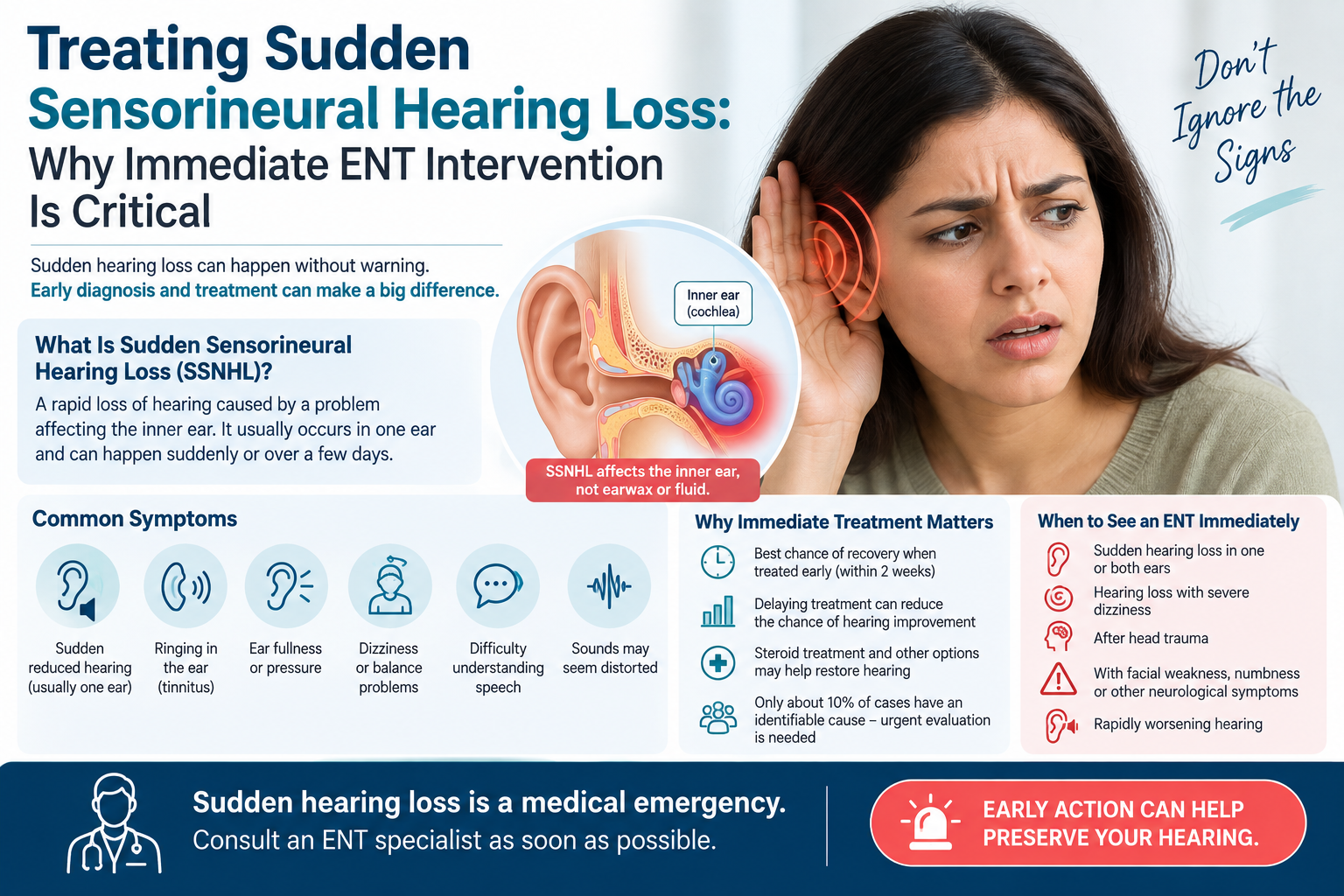
One important cause is Sudden Sensorineural Hearing Loss (SSNHL). Unlike hearing loss caused by earwax or fluid in the middle ear, SSNHL involves the inner ear and requires urgent medical evaluation.
The sooner SSNHL is recognized and treated when appropriate, the better the opportunity to preserve or recover hearing. The National Institute on Deafness and Other Communication Disorders (NIDCD) considers sudden deafness a medical emergency and recommends seeking medical attention immediately.
What Is Sudden Sensorineural Hearing Loss?
Sudden sensorineural hearing loss is a rapid loss of hearing caused by a problem affecting the sensory structures of the inner ear.
It commonly:
- Affects only one ear
- Develops suddenly or over a few days
- May be noticed immediately after waking
- Can occur with tinnitus (ringing in the ear)
- May be accompanied by a feeling of ear fullness
- Can sometimes occur with dizziness or balance problems
A commonly used clinical definition is a hearing reduction of at least 30 decibels across three consecutive frequencies within 72 hours, although smaller sudden changes can also be clinically important.
Why Sudden Hearing Loss Is an Emergency
One of the biggest problems with SSNHL is that people may mistake it for something less serious.
You might assume that the ear is blocked because of:
- Earwax
- Allergies
- A cold or sinus problem
- Ear congestion
- Fluid behind the eardrum
However, SSNHL involves the inner ear, and delaying evaluation can reduce the effectiveness of treatment. Some people recover hearing spontaneously, often within the first one to two weeks, but there is no reliable way to predict who will recover without treatment.
If hearing suddenly decreases in one or both ears, don’t wait several days to see if it improves. Contact an ENT specialist or seek urgent medical evaluation.
What Causes Sudden Sensorineural Hearing Loss?
In many cases, the exact cause cannot be identified. NIDCD notes that only about 10% of people diagnosed with sudden deafness have an identifiable underlying cause.
Potential causes or associated conditions include:
- Viral or other infections
- Head or ear trauma
- Autoimmune disorders
- Certain medications that can damage the inner ear
- Blood circulation problems
- Neurological conditions
- Inner-ear disorders such as Ménière’s disease
Because the cause may not be obvious, professional assessment is essential.
Symptoms You Should Never Ignore
Sudden hearing loss may occur with other symptoms, including:
- Sudden muffled or reduced hearing
- Hearing loss primarily in one ear
- Ringing or buzzing (tinnitus)
- Ear fullness or pressure
- Dizziness or vertigo
- Difficulty understanding speech
- Sounds appearing distorted
The combination of sudden hearing loss and dizziness, severe neurological symptoms, or other concerning symptoms requires prompt medical assessment.
How Is SSNHL Diagnosed?
The first step is determining whether the hearing loss is conductive or sensorineural.
Conductive hearing loss can result from problems such as earwax or fluid blocking sound transmission. Sensorineural hearing loss occurs when the inner ear or related auditory pathways are affected.
An ENT specialist may perform:
Ear Examination
The ear canal and eardrum are examined to identify wax, fluid, infection, perforation, or other visible causes.
Hearing Test
A pure-tone audiogram is important for confirming and measuring sensorineural hearing loss. NIDCD recommends audiometry within a few days of symptom onset when sudden deafness is suspected.
Additional Testing
Depending on the individual situation, your doctor may recommend:
- MRI
- Blood tests
- Balance testing
- Other targeted investigations
These tests can help identify or rule out potential underlying causes.
Treatment for Sudden Sensorineural Hearing Loss
Treatment depends on the suspected cause, severity, medical history, and timing.
Corticosteroids
Corticosteroids are the most commonly used treatment for unexplained SSNHL. They may help reduce inflammation and swelling affecting the inner ear.
They can be administered orally or directly into the middle ear through the eardrum, known as intratympanic steroid therapy.
The American Academy of Otolaryngology–Head and Neck Surgery guideline states that corticosteroids may be offered as initial therapy within two weeks of symptom onset.
Intratympanic Steroid Injections
An ENT may inject steroid medication through the eardrum into the middle ear, allowing the medicine to reach the inner-ear region.
This may be considered:
- As an initial treatment in selected patients
- When oral steroids are unsuitable
- When additional treatment is needed after initial therapy
Hyperbaric Oxygen Therapy
Hyperbaric oxygen therapy (HBOT), combined with steroid therapy, may be offered in selected cases. Current ENT guidance describes it as an option within two weeks of onset and as salvage treatment in certain situations.
Treatment decisions should be individualized by an ENT specialist.
Why Timing Matters
The treatment window is one of the most important reasons not to delay an ENT consultation.
NIDCD notes that steroids should be started as soon as possible when appropriate and that treatment delayed beyond approximately two to four weeks is less likely to reverse or reduce permanent hearing loss.
This doesn’t mean treatment is automatically ineffective after that point. Rather, the potential benefit may decrease with time, which is why early assessment is critical.
What Happens If Hearing Does Not Recover?
Not every patient regains normal hearing despite treatment.
If significant hearing loss remains, your ENT and hearing-care team may discuss options such as:
- Hearing aids
- Assistive listening devices
- Rehabilitation for communication difficulties
- Cochlear implantation in selected cases of severe or profound hearing loss
The appropriate option depends on the degree and type of residual hearing loss and the individual’s needs.
What Should You Do If Hearing Suddenly Drops?
If you suddenly notice that one ear is not hearing normally:
- Don’t assume it’s earwax or congestion.
- Seek urgent medical evaluation.
- Have your ear examined to rule out conductive causes.
- Get a hearing test as soon as possible.
- Follow your ENT specialist’s treatment recommendations.
- Do not delay care simply because the hearing loss is painless.
Early evaluation gives your doctor the best opportunity to identify the problem and consider time-sensitive treatment.
When Should You Seek Immediate Medical Attention?
Seek urgent medical care for:
- Sudden hearing loss in one or both ears
- Sudden hearing loss accompanied by severe dizziness
- Hearing loss after significant head trauma
- Sudden hearing loss with facial weakness, numbness, difficulty speaking, or other neurological symptoms
- Rapidly worsening hearing
Some of these symptoms can indicate conditions other than SSNHL that also require urgent evaluation.
Final Thoughts
Sudden sensorineural hearing loss should never be treated as a routine blocked-ear problem. Because treatment can be time-sensitive, prompt assessment by an ENT specialist is critical.
If you suddenly notice reduced hearing—especially in one ear, with tinnitus, ear fullness, or dizziness—seek medical attention immediately rather than waiting for the problem to resolve on its own.
Early diagnosis, timely hearing testing, and appropriate treatment can give you the best possible opportunity for hearing recovery.